 |
A
BRIEF
HISTORY
OF LUNDY PHILATELY |
| |
A
BRIEF
HISTORY
OF LUNDY PHILATELY |
| QUICK LINKS | Unlike many of the
‘stamps’ bearing the name of other islands
around the UK, Lundy stamps have always had a genuine
postal function. When Martin Coles Harman bought Lundy in
1925, there was a branch of the UK postal authority - the
General Post Office - on the island, and the
island’s previous owner had a contract with the GPO
to carry mail to and from Lundy on his supply ship.
Harman initially continued this arrangement, but when the
contract was due for renewal, the GPO wouldn’t
accept the terms which Harman wanted, so - in his own
words - he ‘dismissed the Post Office’. For
nearly two years he carried the mails to and from Lundy
at his own expense, but he then decided to cover his
costs by issuing his own stamps.
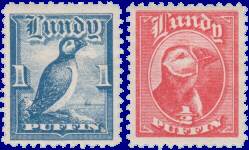
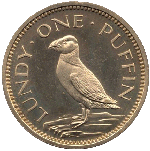
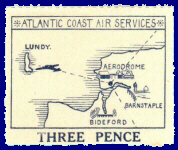
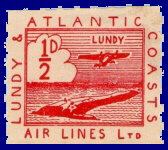
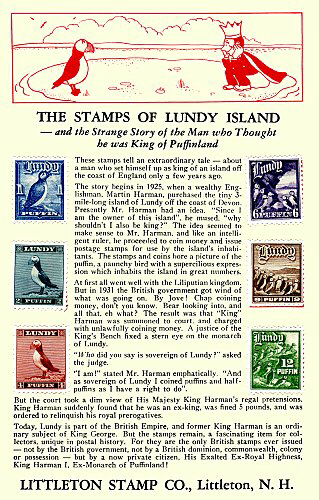
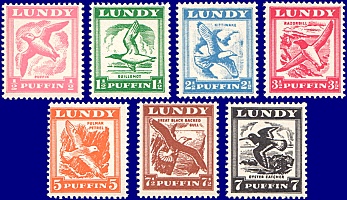
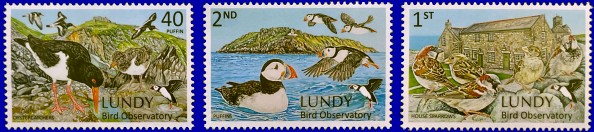
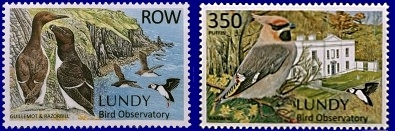
In 1929, the first Lundy stamps came into use. They were denominated not in pennies but in ‘Puffins’. This was the currency which Harman introduced in the same year as a demonstration of Lundy’s supposed independence from the UK. (He was prosecuted for ‘unlawfully issuing as a token for money a piece of metal ... contrary to Section 5 of the Coinage Act 1870’ and found guilty. The coins were withdrawn and sold as souvenirs). Subsequent stamp issues followed at regular intervals. A very fine illustrated reference to Lundy stamps up to 2021 is at http://acsc-history.info/Lundy.html (opens in a new tab). An air service started in 1933 between Lundy and an airfield near Barnstaple at what later became RAF Chivenor; this continued until the outbreak of World War II in 1939. The airlines issued their own airmail stamps in co-operation with the island, though they were not official Lundy stamps.
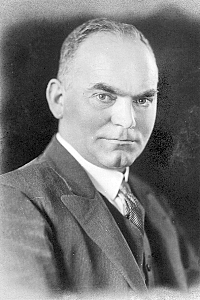
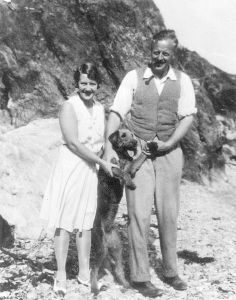
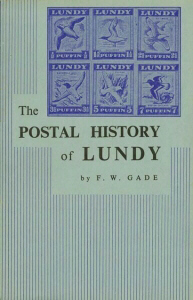
Mail from Lundy had to carry a Lundy stamp to cover the cost of conveyance to the mainland (and an airmail stamp if appropriate), and a normal British stamp to pay for its onward delivery. GPO regulations didn’t permit the Lundy stamp on the front of the envelope so it had to be stuck on the reverse. The person who implemented Martin Coles Harman’s plan for the Lundy postal service was Felix Gade, his resident agent on Lundy. Felix Gade and his wife Rene ran all aspects of the island from 1926 until his retirement in 1971, two years after the Landmark Trust had taken over in 1969 (apart from a short break from 1945-1949). As Lundy’s Postmaster, he oversaw all aspects of new stamp issues and ran the mail service on a day-to-day basis from his office in the Manor Farm Hotel in Lundy’s village. Felix Gade wrote and published the first postal history of Lundy in 1957 and subsequently added two short Supplements.
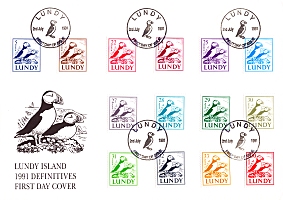
John Dyke was a significant figure in post-war Lundy stamp design. He had taken an interest in Lundy when he was an art student in 1937 and visited the island for the first time in 1948. In 1951 his proposal for a new definitive set of Lundy stamps was accepted - the ‘Flying Birds’ design. Forty years later, he designed the classic ‘Puffins on coast’ definitives, which were re-adopted with new colours and values in 2002 and again in 2023. John Dyke also designed many commerorative sets of stamps for Lundy, including a very attractive Christmas set in 1976.
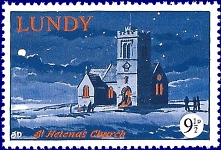
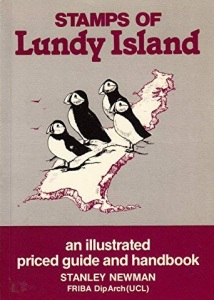
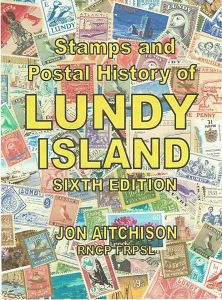
In 1962, the British Post Office allowed Lundy stamps to be stuck on the address side of postcards as long as they were as far as possible from the British stamp. This was extended to all mail in 1992. In 1974, after the Landmark Trust had taken over Lundy and its postal service, the ‘puffinage’ - the cost of carriage between Lundy and the mainland - was combined with the cost of British postage, so only a Lundy stamp for the total cost is needed for outgoing mail. A meter mark is applied on Lundy which shows that British postage has been paid. Various stamp dealers and individual enthusiasts have produced lists and price guides to Lundy stamps, but the first major catalogue was by Barry Chinchen in 1969. The reference numbers he gave to the stamps remained a standard for many years, and were carried forward in Stanley Newman’s 62-page Stamps of Lundy Island in 1984. Newman produced a second edition in 1993 and the series was continued after his retirement by Michael Bale, with a third edition in 1998 and a fourth in 2003. In 2009, Jon Aitchison took over the series with a fifth edition, now greatly expanded and including Lundy’s postal history (which had previously been covered in separate booklets). Jon Aitchison published the sixth edition in 2019, now wire-bound and 436 pages long.
The Landmark Trust maintain a conservative policy with regard to new stamp issues and do not flood the market with new issues in an attempt to make money from collectors. Lars Liwendahl, a leading Swedish philatelist, has been Lundy’s philatelic adviser for many years and works with the island, artists and designers when it is decided to produce a new issue. Lundy today has the oldest and longest running private postal service in the world.
Lundy stamps and coins are available to order by post from The Lundy Postal Service, Lundy, Bristol Channel, EX39 2LY, by phone on 01237 431831 extn 226 or by e-mail lundypostalservice@lundyisland.co.uk. |